
How the Skills Fund Work
The Economic-Finance Model
How the Skills Funds work
Standfirst Two funds, one idea: Texans who already pay property and school taxes invest directly in their neighbours’ training, and earn a return for doing it. No new taxes, no new bureaucracy. Here is exactly how the money moves.
254
Counties, each running a Skills Fund
1,025
School districts, each running an Academic-Skills Fund
8%
Top incentive rate, reserved for investing in the most vulnerable
The Economic-Finance Model
How Public Controlled Capitalism works
Four connected models: two showing how investment cycles through a community, two showing where the money comes from. Choose a model, then select any stage to see how it works.
The County Skills Fund cycle
Taxpayers invest in their neighbors' vocational training. The investor is repaid with a return; the county gains a skilled taxpayer.
Start here
A cycle, not a handout
Every county in Texas would operate a Skills Fund: a pool of money, held separately from all other county budgets, that taxpaying citizens invest into the training of their neighbors.
The investor is repaid their money plus a return. The person they invested in leaves with a certified trade and a job. The county gains a taxpayer where it previously carried a cost.
Select any stage of the diagram to see how that part works.
Stage one
Investors
Three groups can invest: homeowners, landowners, and buy-in citizens. Homeowners and landowners qualify automatically, because they already pay property and school taxes.
Renters and non-owners are not shut out. A buy-in citizen pays the median property and school tax in the county where they live, which earns them the same right to invest in their neighbors.
An investor can back up to three citizens at a time, and may also invest in up to two prisoners each year for vocational training. All taxes must be paid in full by January 31 to stay eligible.
Stage two
Incentive rates
Returns are tiered deliberately. Investing in the most vulnerable citizens earns the highest return, at eight percent. Investing in advantaged citizens earns five percent.
A three percent risk-free rate protects the investor. If the person they backed does not complete the program, for any reason, the investor can recover their expenditures plus three percent.
The structure sends two signals at once: do not give up on your community, and every Texan is a valued citizen.
Stage three
Community colleges
Investment money pays for tuition, fees, books, tutoring, mentoring, and the certification or licensure exams that follow. The training itself runs through Texas community colleges.
Those colleges would put real weight behind the trades the state actually needs: water technology, emissions reduction, air conditioning, cement, electrical, and atmospheric work.
Stand-alone technical schools must affiliate with a Texas community college to qualify. Their finances depend too heavily on student loans and federal grants to be trusted with the state's technical future.
Stage four
Skilled employment
On successful completion, the investor is reimbursed their expenditures plus the incentive rate, and the citizen they backed enters the workforce with a certified trade.
The relationship is not meant to end there. Community colleges teach skills; they do not teach judgment. The investor stays present as a mentor through the responsibilities that follow: continuing education, health insurance, and building savings.
Stage five
Long-term stability
Front-end investment in a trade, paired with sustained mentoring, is what moves a household fifteen to twenty years toward stability rather than instability.
For the investor, community investment becomes an alternative to the stock market: a return they can see, in people they know, in the county they live in.
Returns then flow back into the fund, and the cycle begins again with new investors and new citizens.
The Academic-Skills Fund cycle
The same investment structure, applied earlier: taxpayers fund tutoring and career preparation for students in their school district.
Start here
Investing before the crisis
Each of the state's 1,025 independent school districts would run an Academic-Skills Fund, kept entirely separate from the district's regular budget.
It works on the same principle as the County Skills Fund, but reaches students in primary and secondary school, where the return on a well-timed intervention is highest.
Select any stage of the diagram to see how that part works.
Stage one
Investors
The same three groups qualify: homeowners, landowners, and buy-in citizens who pay the median property and school tax in their county.
Investment is limited to students within the investor's own county, which keeps the money and the relationship local.
Stage two
Incentive rates
The tiers match the county fund: eight percent for investing in disadvantaged students, five percent for advantaged students, and a three percent risk-free rate if the program is not completed.
Principal covers the real costs of academic support, and is reimbursed alongside the incentive rate on completion.
Stage three
Tutoring and mentoring
Funds pay for after-school programs, weekend sessions, and support during traditional school breaks, delivered through the district.
The gap the fund is designed to close is the one no school budget reaches: the student who needs sustained one-to-one attention and has no way to pay for it.
Stage four
Career preparation
Academic support runs into career readiness, so a student finishes secondary school already oriented toward a skilled vocational trade or higher education.
This is where the two funds connect: a student prepared here can move directly into the County Skills Fund pathway for certification.
Stage five
Outcome review
The district and the Community Protection Commission verify the student's progress and the investor's expenditures before any payment is released.
Once validated, the investor is reimbursed with the incentive rate, and those funds return to the pool for the next round.
Where the County Skills Fund money comes from
Two redirected revenue streams, plus a county contribution, capitalize the fund in every one of the 254 counties.
Start here
Money that already exists
The County Skills Fund is not financed by a new tax. It redirects revenue the state already collects and already holds, toward a purpose that returns something measurable to the people who paid it.
Select any stage of the diagram to see how that part works.
Source
The Economic Stabilization Fund
Thirty percent of the state's Rainy Day Fund would be redirected each legislative year toward capitalizing County Skills Funds.
The argument is straightforward: reserves that sit idle while communities go without training are not being stewarded, only stored.
Source
State agency budgets
Thirty percent of the budgets of state agencies and their proxies that do not measurably affect the daily lives of ordinary citizens would be redirected to the same purpose.
This is the provision the proposed "thirty percent rule" referendum would give the governor authority to execute.
Distribution
254 counties
Every county participates. Rural counties contribute two million dollars each legislative year. Urban counties contribute five million per million of population.
Each county sets and reviews its own depletion rate, so the fund is sized to the community rather than imposed uniformly.
Oversight
The Community Protection Commission
Each county seats a five-member commission, appointed by the Commissioners' Court, with membership reflecting the county's demographics. Members are salaried and rotate every three years, training a successor from year two.
The commission validates records, verifies investments, and issues payments, assisted by the County Treasurer and County Clerk.
The fund
County Skills Fund
The fund is maintained entirely separately from all other county budgets, and its money can only be used for two things: returning principal and paying the incentive rate.
Keeping it ring-fenced is what stops it becoming another line item to be raided in a lean year.
Payout
Incentive payments
Investors are repaid their principal plus the applicable rate at the end of the investment period, which is paid no earlier than a year and a day, or upon completion of the program.
That repayment is what closes the loop and funds the next cycle.
Where the Academic-Skills Fund money comes from
Two existing tax streams are redirected from the Foundation School Fund and divided equally among all 1,025 school districts.
Start here
Redirecting what schools already receive
Two tax streams that currently flow into the Foundation School Fund would instead be sent directly to districts, to seed a fund citizens can invest through.
Select any stage of the diagram to see how that part works.
Source
Lottery tax revenue
Thirty percent of lottery tax revenue would be redirected out of the Foundation School Fund and divided equally among all 1,025 independent school districts.
Equal division is deliberate: it prevents the money tracking property wealth the way existing school finance does.
Source
Sin tax revenue
One hundred percent of sin tax revenue would be redirected to the same purpose, again divided equally across every district in the state.
Distribution
1,025 school districts
Each district establishes its own Academic-Skills Fund. Depending on district size, funds are expected to run between roughly one million dollars in rural districts and ten million in urban ones.
Each district determines its own depletion rate over time.
Oversight
The Community Protection Commission
The same county commission that oversees the County Skills Fund may assist the school district and share records with it, so a family's investments are tracked consistently across both programs.
The fund
Academic-Skills Fund
Like its county counterpart, the fund is held entirely separately from all district budgets, and may only be used to return principal and pay the incentive rate.
School money that can be moved is school money that eventually gets moved. This cannot be.
Payout
Incentive payments
Investors are repaid principal plus the applicable rate once the district verifies the student's completion, no earlier than a year and a day after the investment is made.
What it would take
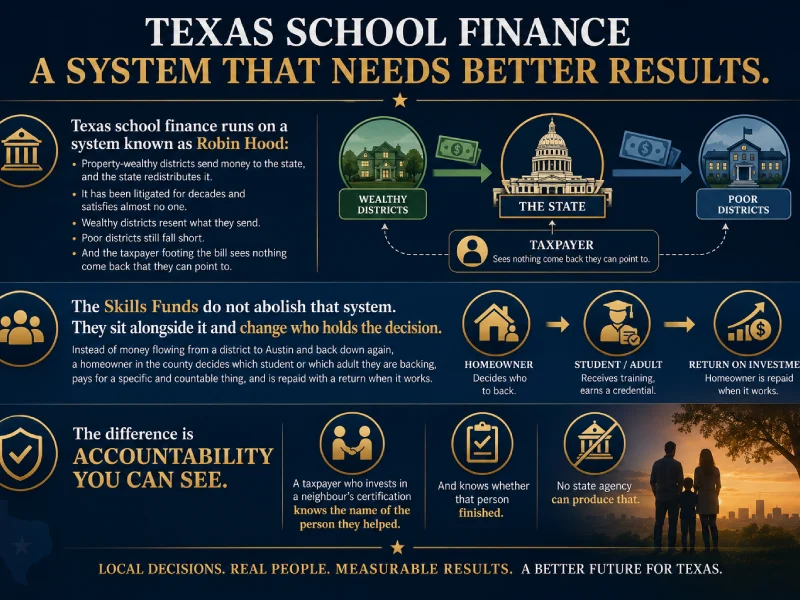
Texas school finance runs on a system known as Robin Hood: property-wealthy districts send money to the state, and the state redistributes it. It has been litigated for decades and satisfies almost no one. Wealthy districts resent what they send. Poor districts still fall short. And the taxpayer footing the bill sees nothing come back that they can point to.
The Skills Funds do not abolish that system. They sit alongside it and change who holds the decision. Instead of money flowing from a district to Austin and back down again, a homeowner in the county decides which student or which adult they are backing, pays for a specific and countable thing, and is repaid with a return when it works.
The difference is accountability you can see. A taxpayer who invests in a neighbour’s certification knows the name of the person they helped, and knows whether that person finished. No state agency can produce that.
The full model is in the book
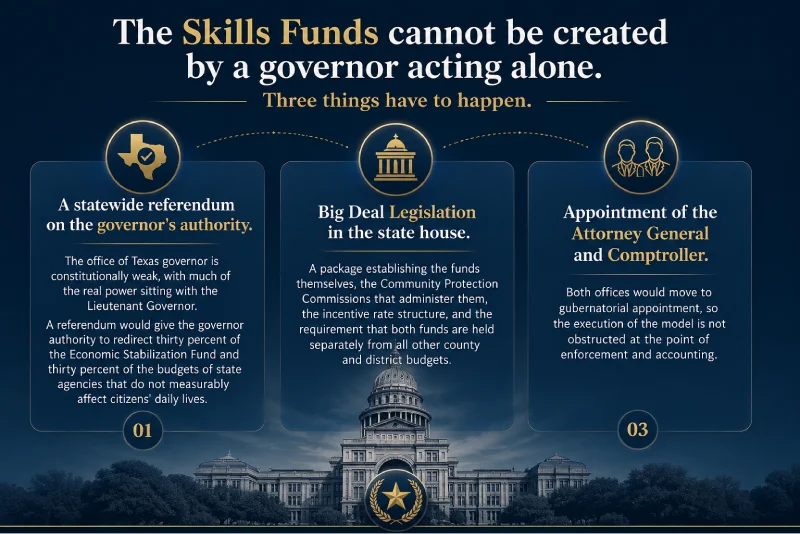
The Skills Funds cannot be created by a governor acting alone. Three things have to happen.
A statewide referendum on the governor’s authority. The office of Texas governor is constitutionally weak, with much of the real power sitting with the Lieutenant Governor. A referendum would give the governor authority to redirect thirty percent of the Economic Stabilization Fund and thirty percent of the budgets of state agencies that do not measurably affect citizens’ daily lives.
Big Deal Legislation in the state house. A package establishing the funds themselves, the Community Protection Commissions that administer them, the incentive rate structure, and the requirement that both funds are held separately from all other county and district budgets.
Appointment of the Attorney General and Comptroller. Both offices would move to gubernatorial appointment, so the execution of the model is not obstructed at the point of enforcement and accounting.
What it would take
The Message: A Time for Repair and Reward in Texas Communities lays out the Economic-Finance Model in full, including the conceptual drawings these diagrams are built from. Chapter 6 brings both funds together.